Showing posts with label Paro. Show all posts

Saturday, 28 May 2022

A few of my Favourite Cities

 
                                                             Samarkand ©Solange Hando

One of the oldest cities on the Silk Road, Samarkand enjoyed a new golden age in the 14th century,  when  the great conqueror Timur made it his capital,  in stunning Islamic style. Later destroyed in troubled times, it was restored in modern days and remains the unmissable attraction in Uzbekistan.

Three madrassas (religious schools), mosques topped with minarets and domes, archways, glistening tiles, flowers everywhere and no traffic on the main square, it's a popular place for wedding or honeymoon photos. Most inspiring for worshippers and visitors alike is the gold-covered Tilla-Kari.


                                                                Istanbul ©Solange Hando

Spreading either side of the Bosphorus, this is a city of two continents, Asia to the east, Europe to the west bustling with palaces and mosques, fountains and leafy squares. Best views of the city and waterways are from the impressive Topkapi Palace rising on the hilltop above the Bosphorus and Golden Horn confluence.

Browse the Grand Bazaar, one the world's largest, see the iconic double-decked Galata bridge and cruise on the Bosphorus, linking the Med. to the Black Sea, past scenic bays, summer palaces and villas and the old fortress guarding the narrowest point.


                                                                    Marrakech ©Solange Hando

Set between the Atlantic and the Sahara, it's the most enticing place in Morocco, high in colour with its tree-lined boulevards and meandering lanes where you may well lose your way. See palaces and mosques, city walls, storks rattling on the old fort and the legendary souks where so many artisans display genuine crafts.

The adjoining Djema el Fna square (above) is for fresh citrus juice, figs, nuts and more in the day but come darkness, this is the heart of town. Musicians, acrobats, dancers, snake charmers, fortune tellers, water sellers, the 'free' show is on every night and if you dare, you can dine local style under the stars. Meanwhile the Koutoubia glows above it all, its slender minaret the unforgettable landmark of Marrakech.


                                                                    Cape Town ©Solange Hando

Fringed by the foaming Atlantic, Cape Town is full of contrast from modern and colonial buildings to breezy avenues or colourful alleyways. Most popular is the bustling Victoria & Alfred Waterfront, restaurants, shops and harbour tinkling with fishing and pleasure boats. Just a short walk away the Sea Point promenade has gorgeous views and plenty of fresh air.

But wherever you are, the dark Table Mountain draws your gaze, rising over 1000 metres.  It's a challenging climb to the top or you can queue for the cable car with revolving platform. Up there the panorama stretches from city and harbour to Robben Island (where Mandela was detained) and coastal peaks all the way to Cape peninsula. Allow plenty of time for the views then explore the quiet trails all around, rich in fauna and flora.


                                                                      Toronto ©Solange Hando

In this multicultural city, the centre is easy to explore on foot as it is generally set on grid pattern. In complete contrast to new buildings and city hall, the old town has historic buildings, including the old city hall with 'Big Ben' like tower. The slender CNN tower (553 metres) is the most iconic landmark with breath taking views over the city and Lake Ontario dotted with lush islands.

Cruising on the lake is a lovely way to relax but save time if you can for the Niagara Falls, roughly 1.5 hour drive, and a day trip you won't forget. Toronto is also the place where you can board the Canadian rail all the way to Vancouver.


                                                                 Cuzco in Peru ©Solange Hando

At 3400 metres up in the Andes, I soon learnt to beware of the altitude and take it easy on the first day or two. No problem, the central square is so colourful you can just sit and watch, from the brightly dressed local women to the glowing colonial churches, the fountain, the pretty balconies and nearby arcades where tea shops recommend cocoa tea (within reason), to cope with altitude.

There are plenty of historic and sacred sites in town, blessed by the large statue of Christ on the panoramic hilltop. Mountains rise all around, fertile valleys below, while just along the trail the Inca ruins of Sacsayhuaman display some of the largest stones ever discovered on such a site.


                                                                 Paro ©Solange Hando


If you fly to Bhutan, this is where you land on a challenging but accessible runway (road only to capital). Dotted with Buddhist temples, this pretty town has traditional architecture, lots of prayer wheels and flags and a magnificent dzong (fortified monastery) reached by a covered wooden bridge across the river. Boutiques and pastry shops are popping up but the local market remains authentic.

Just out of town is the kingdom's most sacred site, Taktsang or the Tiger's Lair, where Buddhism arrived in Bhutan. It's a steep but inspiring trail to the top though there are ponies to the scenic spot half way up. Either way, looking at mountains, forests and valleys, you know you have entered the land of Gross National Happiness and with 800 million trees, the only carbon negative country in the world.


                                                                    Kyoto ©Solange Hando

Laced in waterways at the foot of the mountains, Japan's cultural capital claims myriad heritage gems, from the traditional Geisha district to palace and castle, Shinto shrines and Buddhist temples. Among them are 17 UNESCO sites, including the iconic Kinkaku-ji (above).

Also called Rokuon-ji (deer garden), this Zen Buddhist temple is Kyoto's undisputed icon and as such, a crowded place at first sight. But there's always a quiet corner to appreciate the scene as the Golden Pavilion sends its secret vibes across the lake festooned in tender green leaves and cherry blossom.


Saturday, 27 February 2016

Bhutan, Farmhouse Stay in Paro Valley

Traditional Farmhouse in Paro Valley ©Solange Hando

Bhutan has excellent hotels, in lovely traditional style, but for anyone who would like to get close to the 'real thing' for a day or two, a farmhouse stay is truly rewarding. Simply request it at the time of booking.

It may not be luxurious but accommodation is clean with basic facilities and definitely a warm welcome. It's a genuine chance to live with a Bhutanese family and experience something different.


Heating up Stones for the Bath ©Solange Hando

After a long flight or a day's trek , there's nothing more relaxing than a hot stone bath and most farmhouses will have one. Stones from the river bed are heated on an open fire then carried with pincers and dropped into the small compartment of a wooden tub. The water steams and sizzles and more stones can be added if needed.

No need to worry about emptying the bath for when guests have finished, family members may well follow to make full use of the hot water.


Dinner Farmhouse-Style ©Solange Hando

After the bath, time for dinner, home cooked of course and based on local produce, seasonal vegetables such as spinach or mushrooms, crispy potatoes, cheese sauce and rice, which can be the tasty red variety said to be the best in Bhutan.

Then, there is time to help the children with homework or listen to your host playing a traditional lute before gazing at the stars or retiring to your cosy room draped in colourful rugs and blankets


Smiling Hosts in Farmhouse ©Solange Hando

In the morning, you might wake to the call of a cockerel as your hosts start their working day, milking the cows, putting fresh water in the bowls around the family shrine and cooking breakfast.

Meanwhile, the mountains glow pink in the rising sun, prayer flags flutter on the edge of the paddy and the river tumbles over the stones, mingling its crystalline sound with the twittering of birds.


The Paro Valley ©Solange Hando


Saturday, 15 March 2014

Paro, Gateway to Bhutan

Paro Airport, A Festive Welcome ©Solange Hando

All visitors flying to Bhutan land in Paro, the kingdom's only international airport, roughly an hour's drive from Thimphu, the capital. At just over 2000 metres, it's the perfect place to acclimatise for at least a couple of days before tackling the high Himalayan passes further along the way.

But Paro is well worth a longer stop with much to explore in town and the surrounding area. On a clear day, you can see Jhomolhari, Bhutan's second highest peak, from the ruins of Drukgyel dzong up valley.


Traditional Street in Paro, Bhutan ©Solange Hando


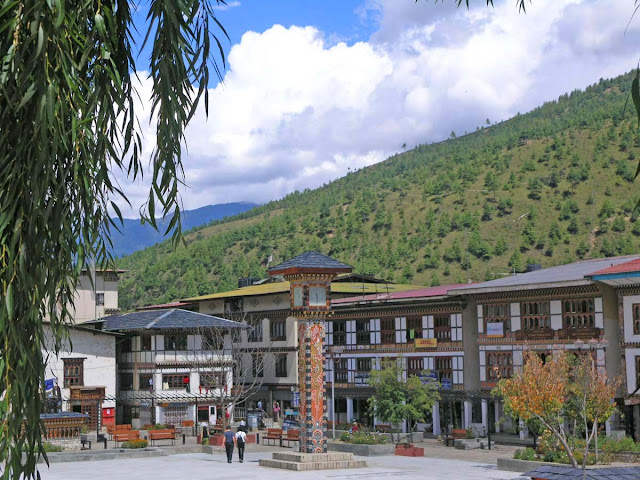
Paro is a lovely little town, laid-back and welcoming, with colourful streets where small shops and houses are finely decorated with carved eaves and window frames. Some have auspicious signs painted on exterior walls, from conch shells and lotus flowers to undisguised phallic symbols.

There are Buddhist flags and prayer wheels, giant incense burners to appease the spirits and chillies drying in the sun. The river babbles over the stones, so clear you could almost see yourself in the water.


Paro Market ©Solange Hando


The local market is one of my favourite spots, barely a tourist in sight, just a fabulous display of garden produce spread on the ground or piled in bamboo baskets, from apples and beans to the ubiquitous chillies.

No one minds you taking pictures and there are plenty of smiling faces.


Taktsang near Paro ©Solange Hando


But for any Bhutanese, Paro holds a special place for it is here that Buddhism was introduced to the kingdom. Just out of town, the Taktsang monastery is one of the holiest sites in the country. 

It's a fair trek from the valley floor, two to three hours depending on fitness, but you can ride ponies to the half way point and enjoy the view over the valley and across the rocky precipice to the monastery, known as the 'Tiger's Lair'.


Paro Dzong and Watchtower on Hilltop ©Solange Hando


Taktsang however is only one of the many religious sites with walls covered in paintings,intriguing horoscopes and prayer wheels you spin for luck. Look out for Kyichu Lakhang set among the paddies and of course, Paro dzong, where festivals are held, with its covered bridge and its old watch tower, now housing the National Museum where pride of place goes to an extensive and highly valuable collection of Bhutanese stamps.


The Bucolic Paro Valley ©Solange Hando

You'll find plenty of accommodation in Paro and around, from traditional lodges and farm stays to up market hotels, and you may well feel you'd like to stay a little longer in this peaceful valley.

Temples aside, there's plenty to do, from country walks to driving to the secluded Haa Valley over the high Chele La pass, relaxing in a hot stone bath or watching an archery contest, but  don't forget, this is only the gateway to the small but amazing kingdom Bhutan...


Sunday, 19 January 2014

Bhutan, Haa valley near Paro

View on the way down the Chelela Pass near Paro ©Solange Hando

The Haa Valley is a hidden gem close to Paro, accessed on the long winding road from Chuzom or if you don't mind a vertiginous short cut, over the Chelela Pass, at 3998 metres, the highest road pass in Bhutan.

It's a spectacular drive with fabulous views on both sides, snowy tops peeping over green conical hills, prayer flags clustered on the pass or tumbling down the slopes and tiny trails scratched into the earth meandering down to the valley far below.


 Haa Valley near Paro ©Solange Hando


Down there, a glistening river babbles over the stones, willows and pines line the banks and traditional houses add a distinctive Bhutanese touch with carved eaves and window frames and auspicious symbols painted on outside walls.


Traditional Architecture in the Haa Valley ©Solange Hando


Here and there a patchwork of fields bears witness to a generous land but everything is on a small scale, pocket-sized allotments, a couple of cows, a man restoring a temple, a woman carrying rice for the monk who meditates in a cave half way up the cliff.


Happy Monks in the Valley ©Solange Hando


As elsewhere in Bhutan, monks are highly respected and play an important role in the community, ensuring an auspicious life for all through daily prayers and religious rituals.

Some choose to live in solitude, most stay in monasteries but either way, Buddhism is a joyful religion here, based on respecting all living things and appreciating the gifts bestowed by the gods and the natural world. 


Bhutanese Dzong above River Gorge ©Solange Hando


That includes the awesome scenery from mountains and valleys to deep river gorges guarded by fortified monasteries known as dzongs.

Here, you never know what awaits around the corner as the valley changes its look, now peaceful, now dramatic, dotted with isolated farms or rustic hamlets gathered around gilded temples.


Fun in the Snow on the Chelela Pass, above Paro ©Solange Hando


And of course, the biggest surprise of all may come on the Chelela Pass when snow flurries can descend like magic in the night but providing the road is open, there's plenty of fun to be had in this happy land.


Monday, 13 January 2014

Bhutan, Taktsang, the Tiger's Lair in the Paro Valley

Paro, Taktsang, the Tiger's Lair ©Solange Hando


Clinging to a rocky ledge, 900 metres above the valley floor, Taktsang is the most holy site in Bhutan and top attraction near Paro, the pretty little town which claims the only international airport.

According to legend, the Tiger's Lair is named after Guru Rinpoche who in the 8th century flew to this spot on the back of a tigress to bring Buddhism to the valley. Before setting off on his mission, he meditated in a cave and over time, the monastery and myriad temples and shrines were built around it.


Prayer Wheel on the Way to Taktsang ©Solange Hando


It's roughly a three hour trek to the monastery, though you can hire a pony to the half way point. The first section takes you through a forest of blue pines and rhododendrons where primroses and orchids bloom along the path. Only bird song and the occasional tinkling of  prayer wheels disturb the silence.


Taktsang from the Lodge ©Solange Hando


Draped in marigolds, a rustic lodge welcomes you half way up, looking out to the monastery, so close yet so far across the chasm and inaccessible, it seems.There's hot tea and soup but if you want lunch on the way down, it's best to order on the way up.

There's a scenic though vertiginous viewpoint on a rock around the corner, a must if this is as far as you want to go.


Waterfall on the Trail to Taktsang ©Solange Hando


After the lodge, the path climbs steeply above the tree line, fringed with holy rocks and caves while temples and shrines nestle on the slopes all around.

At last the monastery appears, almost within reach but first you have to tackle the 775 steps down to the waterfall and footbridge then climb back up to the gate on the other side. If you don't have a permit , this is as far as you can go.


Approaching Taktsang above Paro ©Solange Hando


Hand in your camera at the gate (photographs are not allowed on site) then you can peep into the holy cave and make your way along the dizzying ledge, marvelling at this extraordinary complex where monks can spend up to seven years in solitary meditation in the furthest building. Inside the temple,  incense rises around gilded statues and awesome paintings of gurus and deities and the deep chanting of monks echoes all around.

In 1998, Taktsang was partly destroyed by fire but donations of cash and labour restored to its former self, as dramatic and inspiring as it has ever been.


Rainbow over the Paro Valley ©Solange Hando


For many visitors to Bhutan, Taktsang is the highlight of the trip and whether you go right to the top or just half way, weather permitting, you can expect superb views of the Paro valley, its traditional houses sprinkled here and there, the wooded hills and the river meandering along golden paddies.