Saturday, 29 February 2020

My Favourite Riad in Taroudant, the mini-Marrakech in Southern Morocco

Riad Dar Zitoune in Taroudant ©Solange Hando

Great places to stay in Morocco are the boutique hotels known as riad, traditionally designed and furnished to highlight the local culture.
Dar Zitoune -meaning the Olive- is just outside Taroudant, a pretty town down south with few visitors but lots of atmosphere and a 7km medieval city wall which gave it the name of 'mini-Marrakech.


Luxury Room in Dar Zitoune ©Solange Hando

The two images above were taken in the new Berber Village, the most luxurious section of this 4 star riad where large tented rooms nestle around their own private pool.
Moroccan rugs, fine bedding and traditional patterns along the walls, it's beautifully light and colourful and the perfect place for a special holiday.


Standard Bungalow at Dar Zitoune ©Solange Hando

But before you reach the Berber area, bungalows in pretty colours greet you around the garden among lemon and orange trees, papayas, jacaranda and a profusion of flowers and plants.
My own bungalow was delightful, all the amenities I would expect plus a traditional bathroom glowing with copper and a bed large enough for a whole family. Bungalows are named after local fruit and plants and most have a secluded terrace in their own little garden.


Breakfast Time in the Riad ©Solange Hando

The local staff are helpful and friendly, employed by Swiss owners who simply fell in love with Taroudant and Moroccan culture. The verandah is a lovely place in the early morning or you can eat al fresco under the parasols.
The gourmet restaurant offers local gastronomy like tagine and international fare like pasta or fish curry.


Pottery Garden ©Solange Hando

Then after a  peaceful night or a visit to the town, take time to enjoy this true oasis of peace, wander around the garden where local artists leave a touch here and there, or just sit in the shade or in the sun.
Then of course the standard area has its own swimming pool and if you feel like it, there's a fitness room and a spa with a choice of rituals and a Moroccan hammam. 


Dar Zitoune near Taroudant ©Solange Hando

Here's the entrance to the multi-award Dar Zitoune. The decorated wooden gates on the side are closed after dark when the sweet fragrance of orange blossom rises under the stars.




Saturday, 8 February 2020

Rabat, Enchanting Capital of Morroco

Rabat, River and Ocean ©Solange Hando

Set on the banks of the Bouregreg as it reaches the Atlantic, Rabat is a pleasant city, easy to explore but with few tourists around and population wise, only seventh in the country.
Yet it's an amazing World Heritage Site, listed by UNESCO for its enticing mix of Islamic and Western heritage, ranging from medieval remains to the ambitious new town built by the French.


Mohammed Vth Mausoleum ©Solange Hando

On a hilltop esplanade overlooking river and city, this is the most important site for locals and visitors in the know. 
Marble walls and archways lead to the royal resting place, beautifully quiet and decorated with carved plaster, colourful geometric tiles and a stunning gold leaf ceiling.


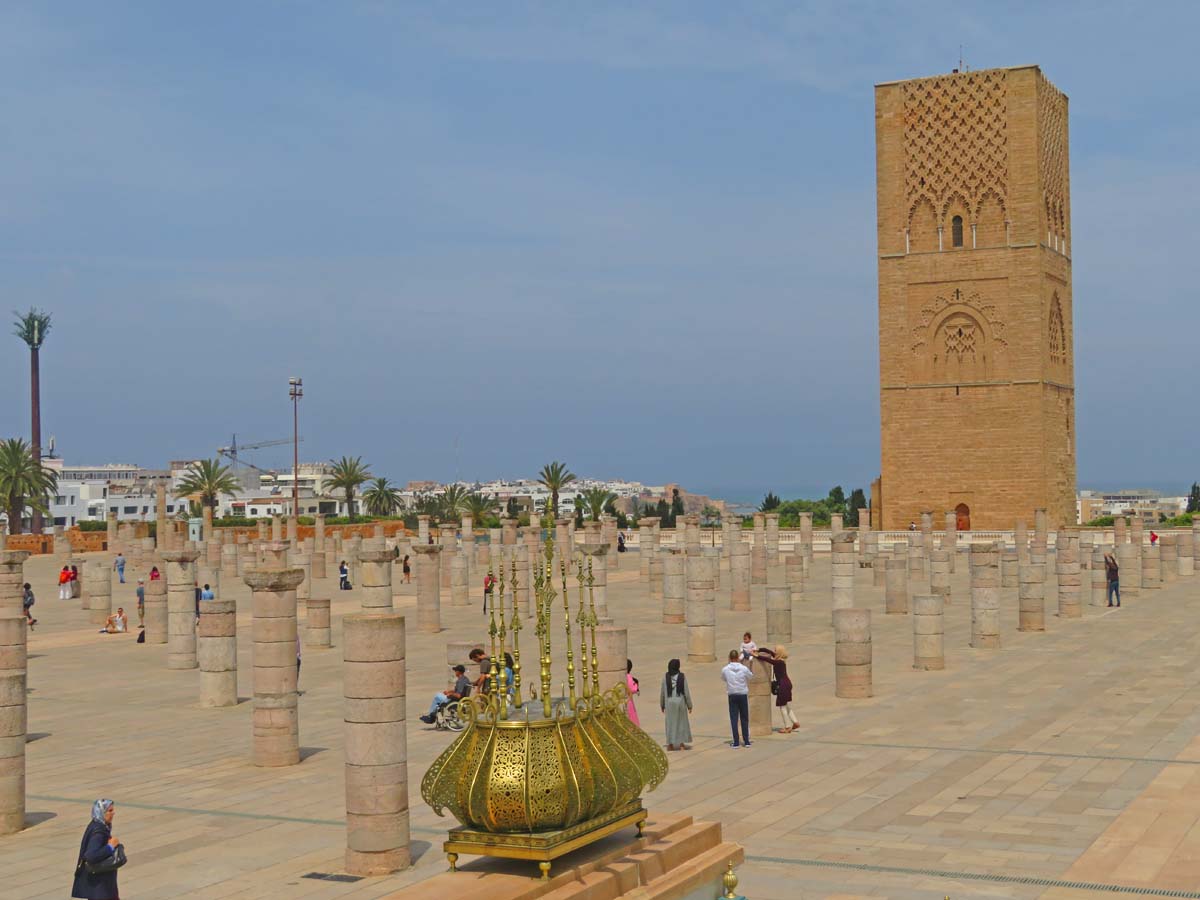
Hassan Tower, Rabat ©Solange Hando

At the other end of the esplanade this red sandstone tower was first built in the 12th century, designed as a minaret for one of the grandest mosques in the world. The mosque was never finished but the tower remains the city's most iconic landmark, 44 metres high. 
The hundreds of circular stone columns at the base were meant to support the roof of the building but all work was abandoned when the Caliph who commissioned it passed away. 


Pretty Corner on the Bouregreg ©Solange Hando

Due to silting, the port is not as important as it was but you can still watch fishermen mending nets on the quay, or you might relax in a secluded cove or stroll along the lovely promenade and enjoy the most delicious seafood al fresco.
You can look across the walls and towers guarding the estuary while the white kasbah on the clifftop just begs to be discovered.


Oudaya Kasbah ©Solange Hando

This is the delightful Oudaya kasbah, a winding maze of deserted alleyways, all blue and white, draped in potted plants and flowers and mosaics glistening around the drinking fountains.
It's a lovely place to wander around, with scenic views from the top, and no commercialisation except a few displays of local craft as you approach the exit.


City Ramparts ©Solange Hando

These glowing ramparts and nearby Andalusian gardens take you back down to the river but if time allows, do have a look at the Chellah complex, on the edge of town, where storks rattle their beaks among remains of the Roman colony and Muslim necropolis.


Time to Relax... ©Solange Hando

You will find beach and hotels in town but if you'd like to escape for a night, make your way to Skhirat, a short drive south, and enjoy a romantic sunset from the 5 star  Amphitrite hotel and pool.


Saturday, 25 January 2020

Love Travel, Love Writing, Want to Sell? Pitch like a Pro.

Follow the Shepherd ©Solange Hando
Pitch before you Jump

Why?
All professionals do, act like a pro. and you'll  be treated like one
The editor may have a similar piece in the pipeline so don't waste your time or theirs
A good pitch will catch anyone's attention, that's enough for a commission


How Do you Do it?
*Focus on a specific angle
*Select the most suitable market for your idea
*Check the travel editor's name (correct spelling) 


Don't
*Don't phone editors, they're busy, only interrupt if highly  topical
*Don't include a biography, all the editor wants is your idea
*Don't offer anything vague or general
*Don't request guidelines, you checked the market, you should know
Don't ask about rates, far too early 


Do
*Allow plenty of time to craft your query 
*Show you are familiar with the publication by writing in similar style
*Be enthusiastic, brilliant but keep it brief,  just enough to whet the appetite
* If you have great images,  send 1 or 2 low res. but mention high res.
*Contact by email, keep the subject line short and specific


Would you like to read more?
Tips, examples, practice and everything you need to know on the road to success
Enjoy and good luck


Saturday, 11 January 2020

2020 Visit Nepal Year

Kathmandu Bodhnath Stupa ©Solange Hando

Following the 2015 earthquake work is still ongoing around the city but this magnificent stupa has been fully restored, thanks to donations. 
One of the largest in the world, it is in the Tibetan district and at dawn and dusk, you can join devotees of all ages walking around the shrine, meeting friends and spinning prayer wheels. 


The Way to Swayambhu in Kathmandu ©Solange Hando

Aptly known as the 'monkey temple', Swayambhu is the other main Buddhist site in the capital with its own stupa and shrines on a hilltop. A taxi can take you to the entrance but walking up through the trees is much more atmospheric.
On a clear day, you can see the snowy peaks of the Himalayas rising above the Kathmandu valley.


On the edge of the city ©Solange Hando

Kathmandu is a bustling place, full of traffic and people, yet you can enjoy the natural world just on the edge of town.
These lovely forested hills are above Bodhnath, close to the Kopan monastery which you can reach on foot or road if you'd rather. No crowds up there, just walking trails though the trees leading to forlorn villages and prayer flags fluttering in the breeze.


Pokhara, Phewa Lake ©Solange Hando

A short flight from Kathmandu, Pokhara is a must-see, a scenic lakeside resort framed by the Annapurna, including the iconic Fishtail in the centre of this picture.
The nearby town is a popular base for trekkers on their way to the Annapurna but the lake delights everyone whether you walk along the banks, sail across the water or head for the Holy Island to relax with the locals and gaze at the view.


The Shanti Stupa in Pokhara ©Solange Hando

Rising on a ridge above the lake, this is one of many pagodas built under the guidance of a Japanese monk to promote peace around the world.
Take a taxi to the gate or walk up through the forest then follow the trail along the hill top to enjoy magnificent views of the lake, the Annapurna range and far beyond (see previous image).


The View from Sarangkot ©Solange Hando

On the other side of the lake, Sarangkot is another attractive spot for close-up views of the Annapurna, just a short drive from Kathmandu and up to the hilltop. Accommodation is available so you can enjoy sunset and sunrise.
Paragliding base nearby.


Sunset on Everest ©Solange Hando

Kathmandu and Pokhara are easy to combine in a short space of time but if you have plenty, then trekking to Everest Base Camp is a true adventure. This image was taken  from the top of Kalapatar, the 'Black Rock' (18209 feet) rising above Gorak Shep, the original base camp.

2020 is Visit Nepal Year so special events will be organised across the country.
Spring is a great time to visit for rhododendrons but for clear views of the Himalaya, mid-October / early November are best. 

Saturday, 28 December 2019

2020, New Decade, New Travel, Want Ideas?

India ©Solange Hando

Adventure
This is Ladakh, India with a difference, a high altitude desert with challenging treks ( Zanskar-Indus confluence above) but you'll find adventure all the way. Explore 'moonland' or drive to Khardung La, the world's highest road pass.
You can fly to the capital  but most dramatic is the legendary road from Manali to Leh.
* Suggested alternative: trek to Everest Base Camp...


Namibia ©Solange Hando

Wildlife
Amazing throughout this vast country, the first in the world to include conservation in its constitution.
Most exciting is the Etosha National Park up in the north. Best time to visit is near the end of the dry season when animals gather around the water holes for survival and scarce vegetation allows superb sightings.
* Or for wildlife of another kind, head for environment-friendly Costa Rica.


Brazil ©Solange Hando

City with a View
You can't beat Rio de Janeiro for scenery, go up Corcovado on the cog railway or take the cable cars up the Sugar Loaf jutting out on a peninsula (above). Then, enjoy the beach, the botanical gardens, the nightlife and bustling streets but if you are there for the carnival, that's definitely something you will never forget.
* My other favourite: Bangkok for waterways, markets and temples.


Canada ©Solange Hando

Slow Travel
Take the train from Toronto to Vancouver and don't worry about time. Goods trains always have priority so you can relax and enjoy the scenery. Dining car with gourmet meals, glass-domed observation car and if you fancy a break on your four night journey, you can book a hotel for a couple of nights in Winnipeg and Jasper.
*Alternative: Qinghai to Lhasa on the world's highest railway. 


South America ©Solange Hando

Iguazu Falls
Out in the jungle these are my top waterfalls stretching on the Argentina-Brazil border. Argentina has more falls and you have to walk across marshland to see the Devil's Throat but the most extensive panorama is from the Brazil side with its famous Santa Maria' fall  and a long 'jetty' for a close up look, if you don't mind getting wet.
* Or see the Victoria Falls, in  Zambia or Zimbabwe (the quieter side).


Bhutan ©Solange Hando

Nature and Culture
Up in the Himalaya, this is my own Shangri La, a remote kingdom where 'gross national happiness' is enshrined in the constitution. The Buddhist culture ensures respect for all living things, from people to the pristine natural world. The image shows you Punakah 'dzong', one of the traditional monasteries, framed by mountains at the confluence of two rivers.
* Or why not go to Japan? Superb mountainous interior and ancient traditions.


Saturday, 7 December 2019

Images of Peru, Cusco, Machu Picchu, Titicaca

Cusco, Main Square ©Solange Hando

At 3400 metres, the former Inca capital is a lovely place with a mix of ancient remains and Spanish colonial buildings. Mountains, flower beds, colonial balconies and arcades, it's all there, around the spacious square or along the steep narrow lanes of the old town.


Santa Domingo in Cusco ©Solange Hando

The church/and convent were built on the site of an Inca temple -to ensure it could never be used again- but remains of the original walls survived earthquakes and are still visible.
The Incas always kept their way and in the cathedral, the Last Supper image is not bread and wine,but Andean cheese and guinea pig (their favourite meat). 


Weaving ©Solange Hando

This lady got it right, beautiful work, so much colour and the best tourist spot around, with great views of Cusco and nearby mountains... Who could resist?


Arriving in Aguas Calientes ©Solange Hando

Cusco is the start of the Inca Trail to Machu Picchu, just 40 km or so but 4 challenging days across the Andes.
The alternative is train or road with stunning panoramas and a chance to visit several Inca sites along the way.


Machu Picchu ©Solange Hando

Unless you trek, access to Machu Picchu is from the lively little resort of Aguas Calientes where a shuttle bus takes you to the site, totally hidden in the mountains.
It simply takes your breath away but be sure to book your ticket well ahead of time for visitors' numbers are restricted.


Pachacutec ©Solange Hando

The 9th Inca Emperor holds pride of place on the square in Aguas Calientes.
One of the most important leaders, he started building Machu Picchu, the work of 50,000 labourers and crafstmen which lasted 50-70 years. 


Lake Titicaca, Uros Islands ©Solange Hando

Shared between Peru and Bolivia, Titicaca (the'puma rock') is the highest navigable lake in the world  and said to be the birth place of the Incas.
It is 190 km long, 80 across at its widest, fed by 25 rivers and dotted with islands.


Traditional Boat on Floating Island ©Solange Hando

Close to the shore but most amazing of all are the floating islands, built with reeds and reshaped  as need be by the indigenous Uros Indians. 
The water is usually calm and perfectly blue and sailing on one of these magnificent reed boats, home- made like islands and huts, is out of this world.


My Friends, the Uros Indians ©Solange Hando


Saturday, 23 November 2019

Bangkok, City of Angels

Wat Po ©Solange Hando

This 'Temple of the Reclining Buddha' is my own favourite in Bangkok, the city's first university now specialising in traditional Thai massage, wonderfully relaxing and energising.

The temple claims 91 stupas (see a few on this picture), over 1000 Buddha images and most revered of all,  the Reclining Buddha, 46 metres long and covered in gold leaf.


Chao Phraya River in Bangkok ©Solange Hando

They call it the River of Kings and its is as busy today as it has always been, river buses and ferries, cargo and tourist boats, including the long tail speed boats ready to cool you down on a hot day.

There are 34 piers altogether, so make sure you know where to get off, but if you end up on one of the canals, you will discover plenty of traditional life along the banks.


Temple of the Emerald Buddha ©Solange Hando

In the grounds of the Grand Palace, Wat Phra Kaew is home to the most auspicious statue, finally brought back to Thailand in the 18th century.

 It measures only 66 cm, possibly made of jasper or jade rather than emerald, and clad in golden clothes which are changed according to season. It is so precious no photographs are allowed so the image above is one of the guardians.


Damnoen Saduak Floating Market ©Solange Hando

There are at least 10 floating markets in the capital but most popular is this one, 80 km away but usually including another attraction or two on a morning trip.

Colour and fragrance is what it's all about it, plus local crafts, souvenirs galore and plenty to eat and drink as you gaze at the incredible traffic jam, only boats of course, punting their way across the water.


Spirit House in Bangokok ©Solange Hando

As pretty as doll houses, these traditional shrines are found all over the city, providing a home for local spirits who may be disturbed by new buildings or people. You find them outside homes, offices, schools and so on.

Incense is burned and offerings are laid out every day, orchids, lotus, water and more. They ensure good luck, prosperity and peace for everyone.


Wat Arun, Bangkok's Landmark ©Solange Hando

Named after a Hindu goddess said to radiate sunrise, the iconic Temple of Dawn is a must see, beautifully lit up after dark though equally stunning during the day when coloured glass and Chinese porcelain glint on the slender spires.

You can climb up part of the central spire -very steep steps, both up and down,- but worth it for the views across the river, from the Grand Palace to nearby temples.


Now can you read Thai?
Don't worry, help is always at hand...

©Solange Hando